Home / Ice safety
Ice safety
Every fact on this page is a quote from a government agency, a park district or a university extension service. None of it describes the ice on any water today. We can’t do that.
“Frozen bodies of water are never 100 percent safe to walk on. It is important to test ice thickness before venturing onto any frozen lake.”
Ohio State University Extension puts it the same way: please remember that no ice is 100% safe.
(Ohio State University Extension) So does Minnesota DNR: Ice is never 100% safe.
(Minnesota DNR)
Ohio DNR’s Indian Lake State Park page says it in five words: Remember, no ice is safe ice.
(Ohio DNR park page, read in a browser November 11, 2026)
Read November 11, 2026; do not rely on it after December 26, 2026.
And about following other people out: Never assume ice is safe because someone else was out before you.
(Minnesota DNR) No matter how well you know a waterbody, remember ice conditions change constantly.
(Minnesota DNR)
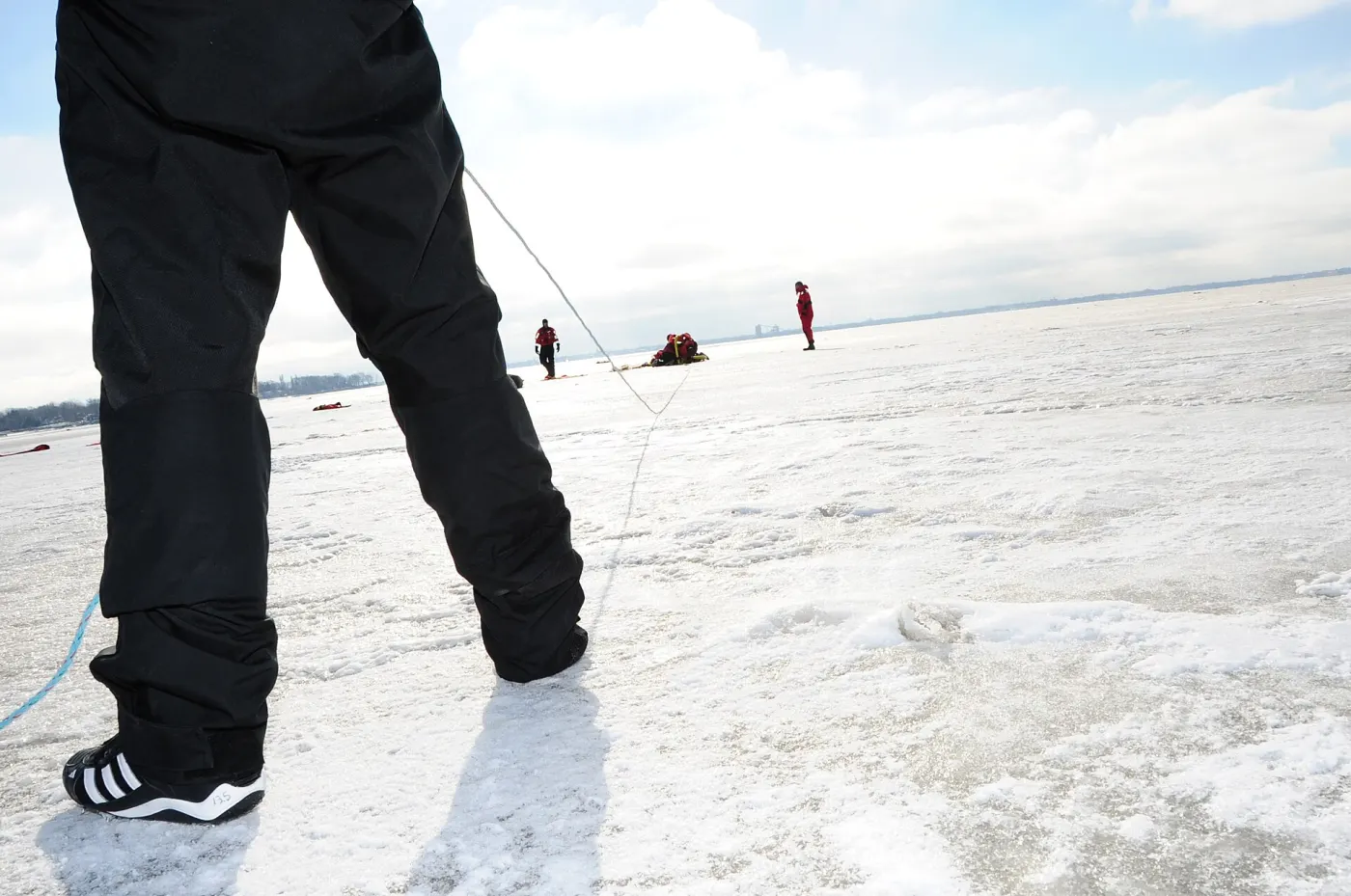
An ice rescue crew from Coast Guard Station Marblehead, Ohio, rescues a victim actor from the ice of Lake Erie during Icy Resolve 2013, an ice rescue training exercise held at the station, Feb. 9, 2013.Photo: Petty Officer 2nd Class Levi Read, U.S. Coast Guard, public domain, via Wikimedia Commons. Lake Erie at Marblehead, Ohio, on February 9, 2013. It is a training exercise with an actor, and it is not a picture of this winter’s ice.

How thick does ice have to be?
The agencies don’t give a number that makes ice a sure thing, and neither do we. Two of them print general figures. Each is shown here as its source prints it, with that source’s conditions attached. They are the agencies’ figures, for ice in general. They aren’t ours, and neither says anything about a particular lake.
Ohio DNR
From ODNR’s Lake Erie access guidebook. The warning and the figure are consecutive sentences there, and the conditions follow directly:
“Frozen bodies of water are never 100 percent safe to walk on. It is important to test ice thickness before venturing onto any frozen lake. A minimum of five inches is recommended for safe enjoyment of ice skating, ice fishing, ice boating, and snowmobiling. Use a chisel, ice auger, or cordless drill (¼-inch bit) to determine whether the ice is thick enough.”
“Ice thickness is not the only factor that affects the strength and safety of ice.”
- “Thawing and refreezing can weaken ice.”
- “Ice seldom freezes uniformly.”
- “The insulating effect of snow slows down the freezing process.”
- “Ice near the shore tends to be weaker due to expansion and warming.”
- “Schools of fish moving warm water up can open holes in the ice.”
Minnesota DNR
| Ice | Minnesota DNR says |
|---|---|
| UNDER 4" | Stay off |
| 4" | Ice fishing or other activities on foot |
| 5" - 7" | Snowmobile or small ATV |
The first three lines of Minnesota DNR’s chart, as it prints them: UNDER 4" Stay off
, 4" Ice fishing or other activities on foot
, 5" - 7" Snowmobile or small ATV
. Its heading: Ice thickness guidelines for new, clear ice only.
(Minnesota DNR) The chart goes on to vehicles, which we leave to the source.
The chart’s own conditions, from the same Minnesota DNR pages. They are part of the chart:
The DNR does not measure ice thickness on Minnesota lakes. Your safety is your responsibility.
(Minnesota DNR)Ice is seldom the same thickness over a single body of water; it can be two feet thick in one place and one inch thick a few yards away.
(Minnesota DNR)Our recommendations are based on average equipment weight and assume solid, clear ice.
(Minnesota DNR)Many factors other than thickness affect ice strength, including air temperature, wind, snow, streams, narrow areas or bottlenecks, sun, shade, fish communities, plant decay, and more.
(Minnesota DNR)When a layer of snow melts and refreezes on top of lake ice, it creates white ice, only about half as strong as new, clear ice. Double the above thickness guidelines when traveling on white ice.
(Minnesota DNR)Ice thickness guidelines do not apply to honeycomb ice. If ice is honeycombed, stay off
(Minnesota DNR).Ice is never 100% safe.
(Minnesota DNR)
The Army Corps of Engineers
The Corps’ Pittsburgh District, about its own reservoirs: Ice fishing is strongly discouraged at all reservoirs, even if the ice is reportedly thick enough to be considered safe.
(U.S. Army Corps of Engineers, 02.19.2025)
How do you check ice thickness yourself?
Minnesota DNR:
An ice chisel or spud bar is a heavy metal rod with a sharp, flat blade welded onto one end.
(Minnesota DNR)Use a chisel to continually check the ice as you walk by stabbing the ice in front of you and making sure the chisel does not break through or make a large crack.
(Minnesota DNR)Checking as you walk with an ice chisel is not a substitute for measuring ice frequently with a tape measure.
(Minnesota DNR)If you are using an auger to check ice thickness, make sure to start by checking thickness near shore and to frequently stop and check as you go.
(Minnesota DNR)Put the tape measure into the hole and hook the bottom edge of the ice before taking measurement.
(Minnesota DNR)Don’t judge ice thickness by how easily a chisel or drill breaks the surface.
(Minnesota DNR)
Ohio State University Extension: Also keep in mind that ice does not freeze uniformly across a body of water.
(Ohio State University Extension)
What is the difference between clear ice and white ice?
Minnesota DNR on clear ice: The ice is clear but can appear blue or black when looking down into the water. This ice is formed with large crystals and few or no oxygen bubbles, creating very solid, strong ice.
(Minnesota DNR)
And on white ice: White ice occurs when snow melts on top of a sheet of ice and refreezes. This type of ice is only about half as strong as new, clear ice because it is full of air bubbles and made up of smaller crystals.
(Minnesota DNR)
Minnesota DNR on snow: The insulating effect of snow slows the freezing process. The extra weight also reduces how much weight the ice sheet can support.
(Minnesota DNR) And on honeycomb ice: Ice thickness guidelines do not apply to honeycomb ice. If ice is honeycombed, stay off
(Minnesota DNR).
Why is Lake Erie ice different?
The Coast Guard’s Great Lakes district, in a release datelined Cleveland:
“Never assume the ice is safe, even if others are on it. Evaluate conditions for yourself and exercise sound judgement.”
“Stay away from shipping lanes and other areas with vessel traffic, as ice is even more unstable and unpredictable in these areas.”
“Ice thickness is rarely consistent. Water currents, particularly around narrow spots, bridges, inlets and outlets are always suspect for weak ice.”
“Stay away from cracks, seams, pressure ridges, slushy areas and darker areas for these may represent areas of unstable ice.”
Coast Guard Sector Buffalo: The Coast Guard reminds the public to exercise extreme caution on ice along Lake Erie, Lake Ontario, the Finger Lakes and the St. Lawrence River.
(U.S. Coast Guard release, February 9, 2023) Each year the Great Lakes region sees multiple accidents due to unstable ice, resulting in people in the water as well loss of personal recreational equipment, such as snowmobiles and ATVs.
(U.S. Coast Guard release, February 9, 2023)
““Never assume the ice is safe, even if others are on it,” said Sector Buffalo Commander Capt. Mark Kuperman. “Ice conditions are highly unpredictable this year, and where you may have safely gone on the ice last year, may be entirely different and unsafe this year.””
Minnesota DNR, writing about its own large lakes, on wind and pressure ridges:
If the wind is blowing out from shore, it can cause the ice you are standing on to break away from shore and float toward the middle of the lake.
(Minnesota DNR)If winds pick up or change direction while you are on early ice, return to shore quickly.
(Minnesota DNR)Ice ridges can range from a few inches in height to over 10 feet high, and they can form in a matter of hours, creating an unexpected obstacle for people returning to shore in the evening.
(Minnesota DNR)Pressure ridges are always dangerous.
(Minnesota DNR)
Cleveland Metroparks, about the Cleveland lakefront: Ice in these areas has more variability than inland lakes so be extra cautious.
(Cleveland Metroparks report, January 30, 2025) People should not venture out onto the ice of the open lake or main Cleveland harbor as it takes a long spell of cold weather to form good ice in these areas, which is a rare occurrence anymore.
(Cleveland Metroparks report, January 30, 2025)
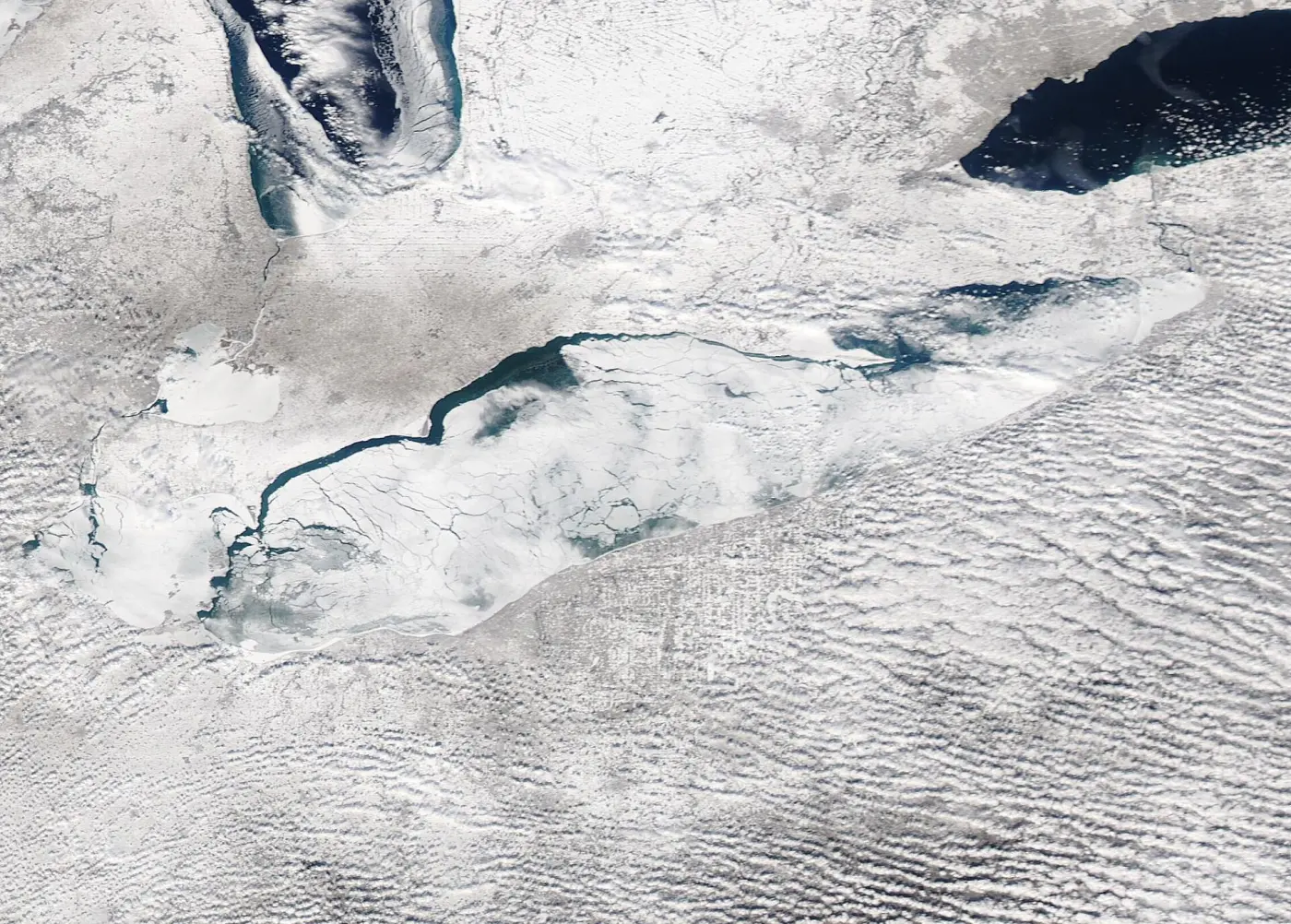
Each year, frigid winter chill brings a topping of ice to the Great Lakes while wicked winter winds force thin ice to shift, breaking it up, and expanding the extent of open water.Photo: MODIS Land Rapid Response Team, NASA Goddard Space Flight Center, public domain, via Wikimedia Commons. NASA dates the image February 14, 2022. It is one day in one past winter and says nothing about the lake now.

What does Ohio require of Lake Erie fishing guides?
A license: No person shall be or serve as a fishing guide in the Lake Erie fishing district without a license from the chief of the division of wildlife.
(codes.ohio.gov) We don’t list or recommend guides. The regional visitors bureau says: Lake Erie Shores & Islands has what you need for a memorable day on the ice, including ice fishing guides and resources.
(Lake Erie Shores & Islands) Nothing we quote says a guide’s license covers the ice, so ask a guide how they check it.
What should you carry?
The Coast Guard’s short version is (I.C.E. = Information, Clothing, and Equipment)
(U.S. Coast Guard release, Feb. 3, 2020):
Know where you are going, how to get there and how to call for help; share this information with friends and family prior to departing.
(U.S. Coast Guard release, Feb. 3, 2020)It is not uncommon for people to become disoriented while on the ice, especially in low visibility or deteriorating weather conditions.
(U.S. Coast Guard release, Feb. 3, 2020)Carry a whistle or noise-making device to alert people of distress and a waterproof VHF-FM radio or Personal Locator Beacon to contact local emergency responders.
(U.S. Coast Guard release, Feb. 3, 2020)Please remember that cellular phone signals can be limited and unreliable in remote areas.
(U.S. Coast Guard release, Feb. 3, 2020)Carry two ice awls or screwdrivers. These instruments can aid in pulling yourself out of the water onto solid ice in an emergency and are more effective than hands alone.
(U.S. Coast Guard release, Feb. 3, 2020)
Minnesota DNR ranks the gear:
A foam life jacket or flotation suit may be the No. 1 item that will keep you alive if you fall through the ice. Most people who fall through the ice die of drowning – not hypothermia.
(Minnesota DNR)Inflatable life jackets are not recommended for cold-water activities.
(Minnesota DNR)Ice picks are the second most-important item. Pulling yourself out of cold water onto a smooth, wet surface with numb fingers is extremely difficult.
(Minnesota DNR)An emergency whistle is an inexpensive item that gives you a chance to call for help if there are others on the lake.
(Minnesota DNR)Always let someone know where you are going and when you expect to return.
(Minnesota DNR)
ODNR: Never walk onto the ice alone and prepare for the unexpected. Wear a life jacket or float coat. Carry a pair of ice picks or large nails in the event of falling through the ice.
(ODNR Coastal (PDF))
Cleveland Metroparks adds rope: A pair of emergency ice picks held at the ready on a cord around the neck are a safety must, as is an emergency length of rope.
(Cleveland Metroparks report, January 30, 2025)
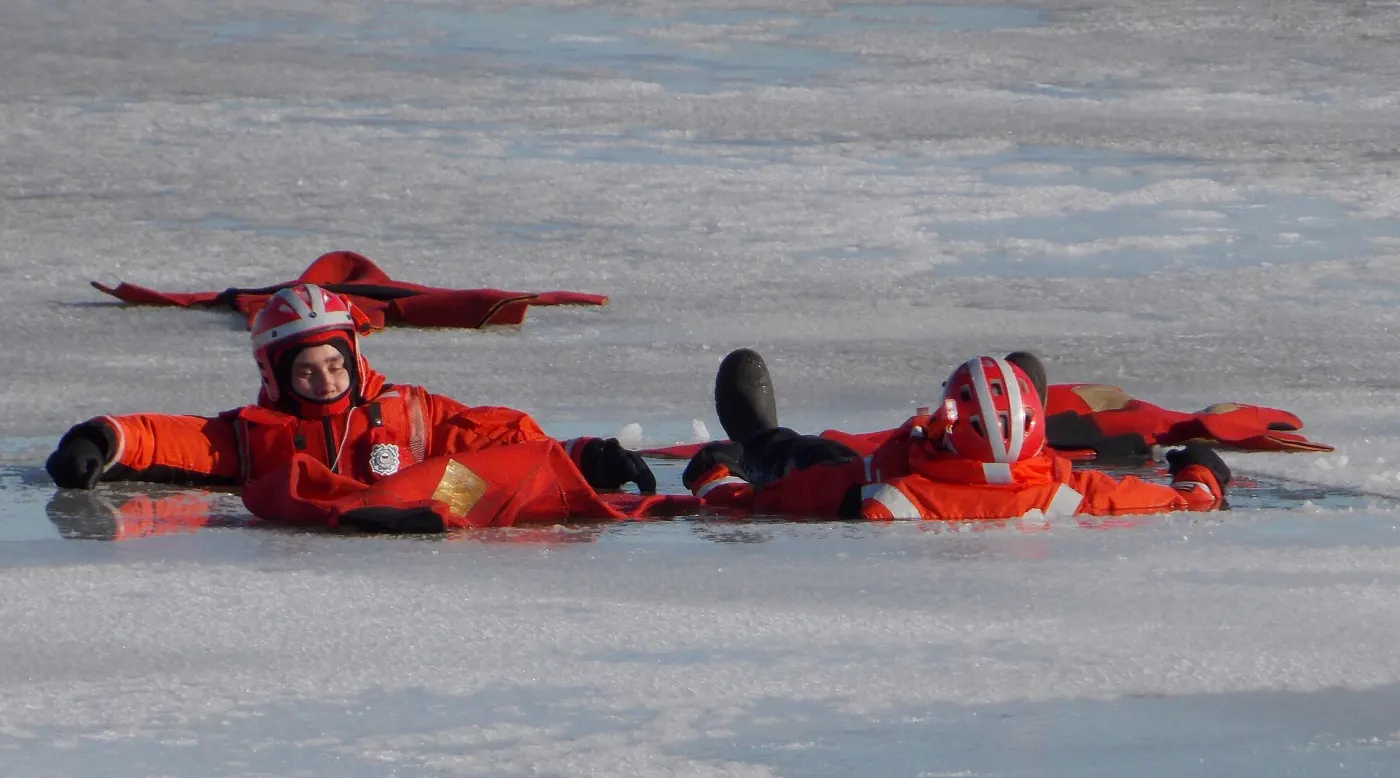
U.S. Coast Guard members acting as simulated victims await rescue in an opening in frozen Lake Erie during the Icy Resolve 2013, a mass rescue full-scale exercise conducted in Marblehead, Ohio, Feb. 9, 2013.Photo: Douglas Colwell, U.S. Coast Guard, public domain, via Wikimedia Commons. Lake Erie at Marblehead, Ohio, on February 9, 2013. The people in the water are Coast Guard members in flotation suits, taking part in an exercise.

What do you do if you go through the ice?
Minnesota DNR’s steps, in order:
First, try not to panic.
(Minnesota DNR)Don't remove your winter clothing. Heavy clothes won't drag you down, but instead can trap air to provide warmth and flotation.
(Minnesota DNR)Turn toward the direction you came. That’s probably the strongest ice.
(Minnesota DNR)Place your hands and arms on the unbroken surface.
(Minnesota DNR)Kick your feet and dig in your ice picks to work your way back onto the solid ice.
(Minnesota DNR)Lie flat on the ice once you are out and roll away from the hole to keep your weight spread out.
(Minnesota DNR)Get to a warm, dry, sheltered area and re-warm yourself immediately.
(Minnesota DNR)
If the ice cracks under you before it gives way, Ohio State University Extension: If you are on thin ice and it cracks beneath you, lie on your stomach, and spread your arms and legs out.
(Ohio State University Extension)
What if someone else goes through?
Minnesota DNR:
First, call 911 for help.
(Minnesota DNR)Resist the urge to run up to the edge of the hole. This would most likely result in two victims in the water.
(Minnesota DNR)If you can safely reach the victim from shore, extend an object such as a rope, ladder, or jumper cables to the victim.
(Minnesota DNR)Toss one end of a rope or something that will float to the victim.
(Minnesota DNR)A non-professional shouldn’t go out on the ice to perform a rescue unless all other basic rescue techniques have been ruled out.
(Minnesota DNR)
Who do you call?
Minnesota DNR’s first step when someone goes through: First, call 911 for help.
(Minnesota DNR) The Coast Guard asks people on the Great Lakes to carry more than a phone: Carry a whistle or noise-making device to alert people of distress and a waterproof VHF-FM radio or Personal Locator Beacon to contact local emergency responders.
(U.S. Coast Guard release, Feb. 3, 2020) Please remember that cellular phone signals can be limited and unreliable in remote areas.
(U.S. Coast Guard release, Feb. 3, 2020) For its reservoirs, the Corps of Engineers’ Pittsburgh District asks for a call before you arrive: Call the ranger station before visiting a lake or trail, so rangers are aware of your presence on site.
(U.S. Army Corps of Engineers, 02.19.2025)
What does the cold itself do?
ODNR: Dress warmly in layers. Wear an inner layer of insulating fabric to trap body heat.
(ODNR Coastal (PDF)) Avoid garments that are 100 percent cotton—they draw heat away from the body. Keep your head, neck, and hands covered, and wear waterproof boots.
(ODNR Coastal (PDF))
Symptoms for hypothermia include uncontrollable shivering, drowsiness, slow or slurred speech, memory lapses, and clumsiness.
(ODNR Coastal (PDF))
Next: the printable checklist, the freeze tracker (weather only), and gear and a first trip.