Home / What bites
What bites through the ice
Only what the sources say. In the ODNR publications our checker can read, the winter passages are about walleye and perch on Lake Erie; for the other three we found general tips. Where a tip isn’t about ice, we say so.
No ice report here. We don’t know the ice on any Ohio water today, and nothing on this page says you can walk on it. Read ice safety first, and check the ice yourself, every few steps, every trip.
Walleye
ODNR’s Lake Erie fishing guide, WINTER WALLEYE (DECEMBER - FEBRUARY)
(ODNR (PDF)):
“In years with sufficient ice, anglers pursue walleye as they make their way back to the spawning grounds. Early in the winter, start off fishing near Catawba Island and end the season off the reef complex west of the Bass islands and north of Camp Perry firing range. Fish with ice fishing lures tipped with minnows, fished just off the bottom.”
Time of day, from ODNR’s Sport Fish of Ohio field guide: Pre-dawn, dusk, and cloudy days are the best times to fish.
(ODNR (PDF))
ODNR’s coastal guidebook: Walleye, white perch, and yellow perch are common ice fishing catches in Lake Erie.
(ODNR Coastal (PDF))
Yellow perch
ODNR’s field guide: Best angling occurs in spring near shore and in the fall through winter at various depths using spreaders with minnows, shiners, worms, or cut bait fished near the bottom.
(ODNR (PDF)) Ice fishing often produces some of the best catch rates for yellow perch.
(ODNR (PDF))
“Fishing for perch during colder months is popular, especially in years with sufficient ice. Anglers use light jigs tipped with minnows or wax worms fished near the bottom. Anglers in the western basin usually target near Catawba, the Bass islands, Marblehead, Sandusky Bay, and harbor areas.”
From the same guide’s general perch tip, which isn’t about ice: They are found in a variety of habitats, but nearly always near the lake bottom.
(ODNR (PDF)) Perch bites are usually soft taps that require attention to detect.
(ODNR (PDF))
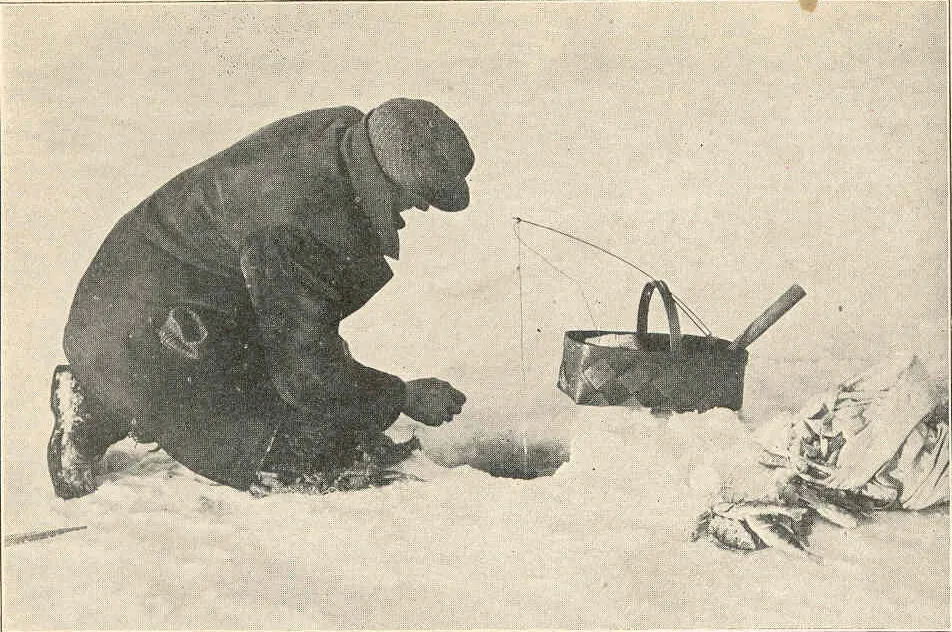
Fisherman on Lake Mendota. About 282,960 perch are caught through the ice each winterPhoto: L. W. Brown, Bulletin of the United States Bureau of Fisheries, public domain, via Wikimedia Commons. Lake Mendota in Wisconsin, not Ohio. The record dates the bulletin 1921, and the perch count in its caption is that bulletin’s, for that lake.

Saugeye
ODNR’s field guide: Saugeye are created by crossing walleye and sauger.
(ODNR (PDF)) Winter is a good time to fish for saugeyes.
(ODNR (PDF)) Live minnows and nightcrawlers are also productive.
(ODNR (PDF))
That passage says winter. It doesn’t say through the ice, and it opens with tailwaters: Many saugeyes are caught in tailwater areas downstream from the lakes and impoundments where they have been stocked.
(ODNR (PDF))
Crappie
At Pymatuning, Pennsylvania’s park page: Walleye, perch, and crappie are most often caught through the ice.
(Pennsylvania DCNR)
ODNR’s field guide, on where crappie hold (a year-round tip, not an ice one): Anglers should concentrate on areas with brush, stumps, and docks.
(ODNR (PDF)) Remember what Pennsylvania’s page says about that kind of cover under ice: Avoid areas with protruding logs, brush, plants, and docks. These structures absorb heat, weakening the surrounding ice.
(Pennsylvania DCNR)
Bluegill
ODNR’s field guide gives bait and hook size, with no season attached: Live or natural bait such as red worms, insects, or wax worms on a small (No. 8 or No. 10) hook are productive.
(ODNR (PDF))
What about trout?
A Cleveland Metroparks fishing report: Ice fishers have been pursuing stocked trout and other species on our inland lakes and ponds as well on the Cleveland lakefront harbors.
(Cleveland Metroparks report, January 30, 2025) That describes one past week. The district’s current report is the place for this week.
The limits we could quote: rules.